How often to groom a goldendoodle, by coat type
How often to groom a goldendoodle depends on the coat. Professional intervals for curly, wavy, and straight coats, plus the brushing that decides them.
On this page
- Most goldendoodles need a professional groom every six to eight weeks, but the coat type moves that to four weeks at one end and twelve at the other.
- Curly coats mat fastest because the dead hair cannot fall out. Wavy sits in the middle. A straighter retriever style coat sheds and can wait longer.
- Brushing at home is what actually sets the interval. An owner who brushes properly can hold eight weeks. One who brushes the surface only cannot hold six.
- Stretching the interval does not save money. It converts a routine groom into a de-matting job, and often into a shave down.
Most goldendoodles need a professional groom every six to eight weeks. Where you land inside that range is decided by the coat type rather than the size of the dog. A tight curly coat needs four to six weeks. A wavy fleece coat sits at six to eight. A straighter, more retriever like coat can often stretch to eight or twelve. Between visits, brush anywhere from daily to twice a week depending on which of those three you have.
That is the answer. The part worth understanding is that the coat type sets the range, and your brushing decides where inside it you actually land.
How often to groom a goldendoodle by coat type
| Coat type | Professional groom | Brushing at home | What goes wrong first |
|---|---|---|---|
| Curly, poodle like | Every 4 to 6 weeks | Daily, to the skin | Tight mats behind the ears and in the armpits |
| Wavy or fleece | Every 6 to 8 weeks | Every 2 to 3 days | Felting along the back and under the collar |
| Straight, retriever like | Every 8 to 12 weeks | Twice a week | Shedding and a packed undercoat rather than mats |
| Puppy coat, any type | Every 6 to 8 weeks | Daily during the coat change | The coat change catches owners out completely |
Move to the shorter end if your dog swims, wears a harness most of the day, is going through the puppy coat change, or has already matted once. A coat that has matted once tends to do it again in the same places.
Two things about that table are worth saying plainly, because page one of this search is mostly other owners guessing.
The first is that a goldendoodle is not one breed of coat. An F1 cross can throw a coat much closer to the retriever side, and those dogs genuinely shed and genuinely do fine at ten weeks. A multigenerational doodle bred toward the poodle side is a four to six week dog for life. Sorting yours into one of the three rows above matters more than any number you read.
The second is that our guide to how often you should groom a golden retriever is largely a story about shedding seasons. Almost none of that transfers to a curly doodle, for the same reason it does not transfer to a Shih Tzu. On a shedding coat the dead hair leaves. On a curly coat it stays, wraps around the hair still growing, and knits into a mat. Nothing about that pauses in January.
When should a goldendoodle get its first haircut?
Around four months for a short introductory trim, then full styling from about eight or nine months.
The first appointment is not really about the haircut. It is about a puppy learning that the table, the clippers, the dryer and having its feet held are all unremarkable. A doodle that learns this at four months is easy to groom for the next twelve years. A doodle whose first visit happens at ten months, already matted, learns the opposite lesson, and that is much harder to undo.
The puppy coat change usually arrives between eight and twelve months, and it catches almost everyone out. The soft puppy coat is pushed out by the adult coat and has nowhere to go, so a dog that has never matted suddenly mats everywhere in about a fortnight. Brush daily through that window regardless of what the calendar says.
How often should you brush a goldendoodle between grooms?
Daily for a curly coat, every two to three days for a wavy one, twice a week for a straight one. The technique matters more than the frequency.
The common failure is brushing the top of the coat. A doodle can look perfectly fluffy on the surface and be matted flat against the skin underneath. The fix is to brush in sections, lifting the hair and working down to the skin, then following the slicker brush with a metal comb. If the comb will not pass through cleanly, the brush did not do its job.
Bathing without brushing out first is the other one. Water tightens an existing tangle into a solid mat that then has to be cut out, so a bath on an unbrushed doodle actively makes things worse.
The between-visit schedule: nails, ears, teeth, and eyes
Everything above is about the coat, which is what sets the appointment. These jobs run on their own clocks and do not wait for it.
| Task | How often | Why this interval |
|---|---|---|
| Full brush out to the skin | Daily to twice a week, by coat type | The one thing that actually decides your groom interval |
| Bath | Every 4 to 6 weeks, always brushed out first | Water on an unbrushed doodle tightens tangles into mats |
| Nails | Every 3 to 4 weeks, usually at the groom | Long nails change how the dog stands |
| Ears checked and cleaned | Weekly, plucked or trimmed as your groomer advises | Doodles inherit hairy ear canals from the poodle side and trap moisture |
| Teeth | 2 to 3 times a week | Nothing to do with the coat, and the job most often skipped |
| Hair around the eyes | Checked weekly | Grows into the eye on a fuller face trim and irritates it well before the next visit |
Nails and pads land at the appointment on a six to eight week cycle, so those look after themselves. Ears, teeth and eyes do not, and a doodle that swims needs the ears checked after the swim rather than on a weekly calendar.
Why do groomers charge extra for doodles?
This is the top question people also ask on this search, and the honest answer is chair time.
A doodle is priced above its weight because the coat is slow. It has to be brushed out completely before the clippers touch it, clipped evenly, then dried straight and combed again, and every one of those steps takes longer on curly hair. A well maintained large doodle holds the table for about ninety minutes where a similarly sized smooth coated dog is done in fifty. Add matting and you add careful, uncomfortable hand work on top, which is what pushes an overdue coat past two hours.
We run the software behind grooming salons rather than the clippers, so treat that as a view from the booking side rather than from the table. What we see in the data is consistent with what groomers say out loud. The doodle surcharge is not a breed tax. It is a time charge, and the amount of time is set largely by how long the owner waited. Our guide to how much to charge for dog grooming makes the same case in full, with de-matting priced as a separate line rather than absorbed quietly into the base price.
How long does it take to groom a goldendoodle?
Around ninety minutes for a well maintained standard doodle, less for the smaller sizes, and thirty minutes to an hour more once the coat is overdue.
| Doodle size | Well maintained coat | Overdue coat |
|---|---|---|
| Mini, under about 25 lb | 60 to 75 minutes | 90 to 120 minutes |
| Medium, about 25 to 50 lb | 75 to 90 minutes | 2 to 2.5 hours |
| Standard, over about 50 lb | about 90 minutes | 2.5 hours or more |
The reason the second column exists is the order of operations. A doodle has to be brushed out completely before a blade touches it, so on a maintained coat that step takes ten minutes and on a felted one it becomes the appointment. That is also why a booking slot set by size alone runs late: the same standard doodle is a ninety minute dog at six weeks and a two and a half hour dog at twelve.
If you are booking your own dog in, ask what slot length the salon has put you in and be honest about when it was last done. If you are the salon, the interval you hold is the thing that keeps the slot accurate.
What happens if you stretch the interval?
You do not save money. You change what the appointment is.
Once mats are tight to the skin, no groomer can brush them out without hurting the dog, and the humane option becomes a shave down. That means losing the coat you were growing, and a doodle coat takes months to come back. The de-matting charge on top is usually larger than the difference between two ordinary appointments would have been.
Here is the arithmetic, using US dollars as a reference that works the same in any currency. Take a standard doodle at a $110 full groom.
- On a five week cycle, that is 10.4 visits a year, about $1,144, at roughly 1.5 hours per visit.
- On a twelve week cycle, that is 4.3 visits a year. But each one is now $110 plus a $30 de-matting fee, so about $606, at roughly 2.5 hours per visit.
The owner on twelve weeks pays more per visit and less per year. The salon earns about $73 per chair hour on the five week dog and about $56 on the twelve week one. Nobody wins by waiting. That is the number worth putting in front of an owner who is trying to save money by skipping a cycle, and you can re-run it with your own prices in about a minute.
What this means if you groom doodles for a living
If you are the salon rather than the owner, everything above is a rebooking problem wearing a coat.
You already know the right interval for every doodle on your books. You said it at the counter. The gap is that six weeks later the owner is not thinking about it, and the dog arrives at week eleven needing the two and a half hour version.
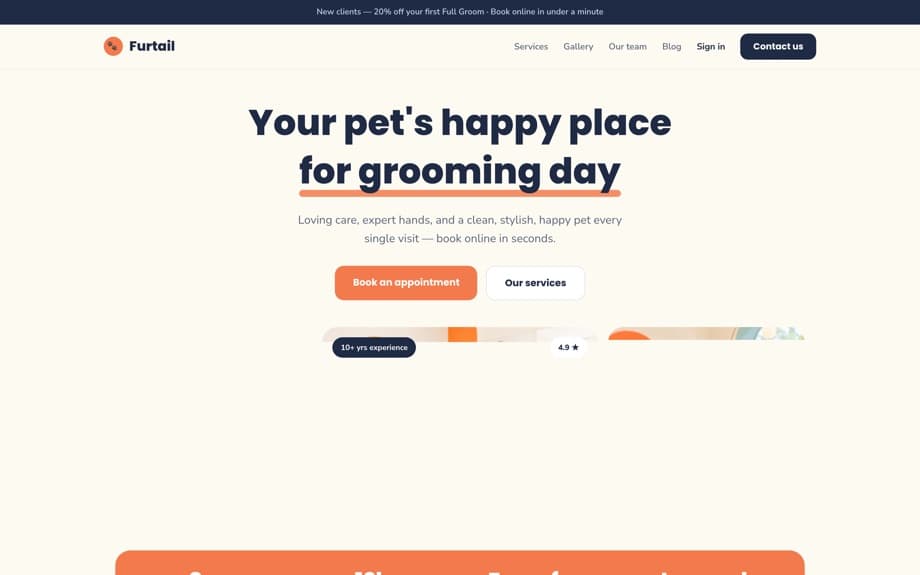
That is a live grooming site we run, not a mockup. The booking page behind it is where a rebooking reminder lands.
We build the software that closes that gap, so this is our view rather than neutral advice. The version that works is a system that already knows each dog's interval and contacts the owner when it comes due, instead of a list you mean to call through on a quiet Tuesday. Our help guide on recurring visits shows how the interval is set per customer and how the reminder goes out with a one tap link to book the next visit. Being plain about the limit: those reminders are email, not text messages. If your book runs on SMS today, that is a real difference to weigh before you switch.
The wider version of this argument, across every breed rather than one, is in bringing grooming clients back automatically, and our page for grooming salons shows how the whole setup goes together. For the complete coat by coat picture, our guide to how often you should groom your dog has the full table.
For owners, the short version is easy to carry. Work out which of the three coats you have, brush to the skin rather than across the top, and let the coat rather than the calendar decide when to book.