Dog grooming business plan (free template)
A dog grooming business plan you can actually fill in. Six sections, the numbers that decide whether it works, and a template built for a working salon.

On this page
- A dog grooming business plan is a working document of about six pages, not a forty page document for a bank.
- The three numbers that decide whether the business works are your price per groom, how many dogs you can physically do in a day, and how often each dog comes back.
- Most plans skip the third number, which is the one that separates a salon that grows from one that stalls.
- Write it in an afternoon, then revise it after your first twenty real customers when you have actual figures.
A dog grooming business plan is a short working document that sets out what your salon does, who it serves, what you charge, what it costs to run, and how customers find you and come back. For most groomers it runs to about six pages, and its real job is to force you to answer questions that are expensive to get wrong later.
It is not a forty page document for a bank, unless a bank has specifically asked you for one. Write the working version first.
The six sections
Skip the corporate template. These are the sections that change decisions.
1. What the business is
Three or four sentences. The operating model (salon, mobile van, or home based), where you work, who does the grooming at the start, and the legal structure you are registering. Structures differ by country, so this is a sole trader or limited company in some places and an LLC or sole proprietorship in others. Your local business registry will tell you the options.
Write the operating model down explicitly, because almost every later number depends on it. If you are leaning mobile, our guide to starting a mobile dog grooming business covers the cost differences in detail.
2. Who it serves
Not "dog owners". Be specific enough that it changes what you buy and what you charge. A salon built around doodles and other high maintenance coats needs different drying equipment, longer appointment slots, and a higher average price than one built around short coated dogs and quick tidy ups.
The useful test: if your answer does not change your equipment list or your slot length, it is not specific enough yet.
3. What you charge
This is the section most new plans rush, and it is the one that sets the ceiling on everything else. You need a price per service, not a single number, and you need to know how long each service actually takes you.
We have a full breakdown in how much to charge for dog grooming, which works through pricing by size, coat type, and time rather than guessing from what the salon down the road charges. Read that before you fill this section in.
Fill in your own figures:
| Service | Your price | Minutes it takes you | Price per hour |
|---|---|---|---|
| Full groom, small short coat | |||
| Full groom, large or double coat | |||
| Bath and tidy | |||
| Nails only | |||
| De-shedding add on |
The right hand column is the one to look at. Groomers regularly discover their most popular service is their worst paid per hour.
4. What it costs
Two lists. One off costs to open, and recurring costs to stay open.
To open: grooming table, bath or tub, high velocity dryer, clippers and blades, shears, brushes, restraints, towels, initial stock of shampoo, insurance, licensing or registration fees, and either fit out for a unit or a van and its conversion. If you are mobile, add a water and power solution.
Every month: rent or van finance and fuel, insurance, utilities, shampoo and consumables, software, marketing, and your own pay. Include your own pay. A plan that only works because the owner is unpaid is not a plan.
Prices for all of this vary enormously by country and by whether you buy new or used, so filling in real quotes from real suppliers in your area beats any figure a guide like this one could print.
5. How customers find you, and come back
Two halves, and almost every business plan template online writes only the first one.
The first half is being findable. A website that shows your work and lets someone book without phoning, a Google Business Profile, and photos of real grooms. Our post on how to get more grooming clients covers this half properly, and why online booking beats phone tag explains why the booking step matters more than most owners expect.
The second half is the one that decides whether you are still growing in year two: what happens after a dog has been groomed once. If every client has to remember to rebook on their own, a predictable share of them will not, and you will spend year two refilling the same diary you filled in year one.
Put an actual mechanism in this section, not an intention. Something that tracks when each dog is due based on its coat and last visit, and invites the owner back before they drift. Our guide to how often you should groom your dog has the breed and coat table you would base those intervals on, and bringing grooming clients back automatically covers the mechanism itself.
6. The first year, month by month
A simple table. Expected dogs per week, average price, revenue, fixed costs, and what is left. Twelve rows.
Be pessimistic in months one to three. Almost every new salon plans a faster ramp than it gets, and the plans that survive contact with reality are the ones that assumed a slow start and budgeted for it.
The three numbers that actually decide it
Everything above condenses into three figures:
- Price per groom. What you charge.
- Capacity. How many dogs you can physically do in a day without rushing or hurting yourself.
- Return frequency. How often each dog comes back.
Most plans work hard on the first two and ignore the third. That is a mistake, because the third is the cheapest one to improve. Winning a new client costs marketing effort and time. Getting an existing, happy client to come every eight weeks instead of every twelve costs a reminder at the right moment.
A client on a six week cycle is worth roughly twice a client on a twelve week cycle over a year, for the same one time cost of winning them. That is the whole argument for putting rebooking in your plan as a system rather than a hope.
If you want those three numbers turned into an actual salary, we worked the full arithmetic in how much dog groomers make, covering both what a commission groomer earns and what is left for the owner after costs.
What we would put in the plan
We build the software side of this for grooming salons, so treat the following as our view rather than neutral advice.
In section 5, we would write down one specific line: every completed groom schedules the next contact automatically, based on that dog's coat and how long since its last visit. Not a note to chase people. A mechanism that runs whether or not you remember.
That is what our help guide on recurring visits sets up, and it is the reason we exist as a product rather than as another booking calendar.
Section 5 also needs the website line, and it is worth seeing a real one rather than imagining it. This is a live salon site running the booking flow, not a mockup:
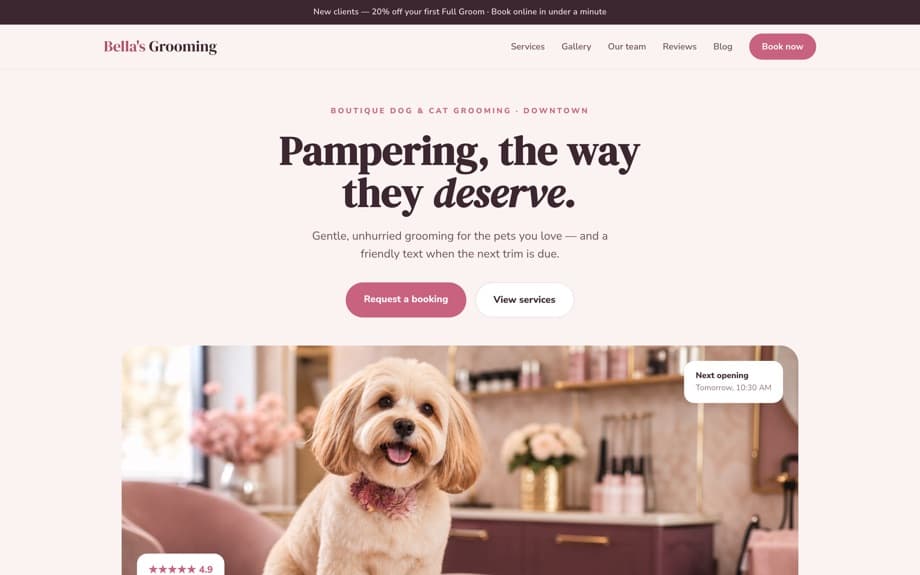
You can open that one and four others from our demo portfolio and put a test booking through to see what the owner and the customer each receive. If you want the wider picture of running the salon day to day once it is open, our pillar guide on running and growing a dog grooming business picks up where this plan stops.
Write it in an afternoon
The plan is not the point. The decisions are. Give yourself an afternoon, fill in the six sections with real quotes and real prices, and accept that sections 3 and 6 will be wrong.
Then revise it after your first twenty paying customers, when you know how long a doodle actually takes you and how many of those twenty came back. That second version is the one worth keeping. If you have not opened yet, our step by step guide to starting a dog grooming business covers the registration and setup order, and our page for grooming salons shows what we put in place once you are trading.