How much do dog groomers make (the owner-side answer)
How much do dog and pet groomers make, worked out from dogs per day, average ticket and commission split, plus what a salon owner actually takes home.
On this page
- A commission groomer's pay is dogs per day times average ticket times the split. Move any one of those three and the annual figure changes by tens of thousands.
- On our arithmetic, four dogs a day at a $60 average pays a groomer about $27,600 a year on a 50 percent split. Six dogs a day at $75 puts the same groomer near $51,750.
- A solo owner-operator often takes home roughly what a busy employed groomer earns. The gap only opens once a second chair is filled.
- Chair time is the product and it does not keep. A slot lost to a no-show is revenue that cannot be sold again later in the day.
A dog groomer working on commission in a salon typically earns somewhere between $27,600 and $51,750 a year, and the gap between those two numbers has almost nothing to do with skill. It comes from three inputs: how many dogs go through the chair each day, what the average ticket is, and what percentage of that ticket the groomer keeps. A salon owner is a different question again, and page one of this search does not answer it at all.
The figures here are in US dollars as a reference point. The arithmetic works the same in any currency, so swap in your own numbers and re-run it.
How much do dog groomers make per hour, per day, per month and per year?
The most common salon arrangement is a commission split, usually somewhere between 40 and 60 percent of each ticket. Everything below assumes 50 percent, so you can re-run it against whatever split you actually pay or receive.
| Quieter book | Full book | |
|---|---|---|
| Dogs per day | 4 | 6 |
| Average ticket | $60 | $75 |
| Salon sales per day | $240 | $450 |
| Groomer at 50 percent | $120 | $225 |
| Effective hourly, 8 hour day | about $15 | about $28 |
| Per five day week | $600 | $1,125 |
| Per calendar month, the year averaged out | about $2,300 | about $4,310 |
| Across a 46 week year | $27,600 | $51,750 |
The monthly row is the annual figure divided by twelve rather than the weekly figure times four, and the difference matters. A groomer working 46 weeks is unpaid for six of them, so budgeting from a good week overstates the month by about $300 on the quieter book and by nearer $560 on the full one. Read the monthly line as what lands across a year, not what a busy month looks like.
Tips sit on top of that and are genuinely material in this trade, but they are not predictable enough to plan a business around, so we leave them out of the model.
Notice what the two columns actually differ by. The busier groomer does two more dogs a day and charges $15 more per dog. That is it. Those two small changes nearly double the annual figure. Anyone telling you groomer pay is a fixed number for a region is describing an average of books that look nothing like each other.
Do pet groomers make good money?
Set against other trades you can enter without a degree, yes, but only at the top of the range, and the range is unusually wide for one job title.
The table above is the reason. A groomer on a half full book at modest prices lands near $27,600, which is not good money in most US markets. The same person, with the same skill, on a full book at large dog pricing lands near $51,750 with tips on top. Nothing changed between those two lines except two more dogs a day and $15 on the ticket.
So the honest answer is that grooming pays well when the diary is full and badly when it is not, and how full the diary gets is mostly not the groomer's doing. It is set by how the salon prices, how reliably it rebooks, and how many slots it loses to people who do not turn up. If you are weighing this up as a career, ask a prospective shop what its average ticket is and how far ahead the book is filled. Those two answers tell you more than the advertised rate does.
Mobile groomers are the exception to the salon arithmetic, because the ceiling is set by the drive between stops rather than by the chair. We ran that model separately in how much mobile dog groomers make, where the owner lands between about $33,000 and $68,000 a year depending on route density.
Why the published salary averages do not answer an owner's question
Search this term and you get salary aggregators and training school pages. Both are answering a different question than the one a salon owner is asking.
The aggregators average employed groomers across every kind of shop, from a big-box bathing line to a two-chair boutique, and report a single national figure. That number is real, and it is useless for deciding what to pay a groomer next month, because it contains none of the three inputs that decide the answer. The training school pages have a further problem, which is that they are recruiting copy. A page whose purpose is to enroll you in a grooming course has an obvious reason to quote the top of the range.
We build software for grooming salons, so treat this as our view rather than neutral advice. What we see is that owners who set pay from a published average end up either overpaying a slow chair or losing a good groomer to a shop that pays commission honestly. The split is the negotiation. The average is not.
How much does a dog grooming business make, and what does a self-employed groomer take home?
A one-chair dog grooming business run by its owner makes about $69,000 a year in revenue, and the owner keeps about $47,880 of it before tax. Here is the version nobody on page one runs, for a solo owner-operator grooming four days a week and keeping the fifth for admin, phone calls and cleaning.
Five dogs a day at a $75 average is $375 a day, or $1,500 a week. Across 46 working weeks that is $69,000 of revenue, roughly $5,750 a month.
Now the costs, monthly:
| Cost | Monthly |
|---|---|
| Rent and utilities on a small unit | $1,200 |
| Liability insurance | $80 |
| Shampoo, consumables, laundry | $250 |
| Booking software and website | $60 |
| Card processing at about 3 percent | $170 |
| Total | $1,760 |
That is $21,120 a year, which leaves the owner about $47,880 before tax.
Read that against the table above. A busy employed groomer on a 50 percent commission clears roughly $51,750, carries no lease, replaces no clippers and goes home when the last dog does. The solo owner earns slightly less for considerably more risk.
This is not an argument against owning a salon. It is an argument that the first chair does not pay you for owning anything. It pays you for grooming.
Stated as income rather than as revenue, that is a self-employed dog groomer income of about $47,880 a year against an employed groomer income of about $51,750, on the same five dogs a day. The revenue number is the one that gets quoted. The income number is the one you live on.
A self-employed dog groomer does not draw a salary the way an employee does, so that $47,880 is the salary figure to hold up against a job offer. Divided across twelve months it is about $3,990, and it arrives unevenly, because the six unworked weeks and any slow month come out of it rather than out of an employer's payroll.
Is a dog grooming business profitable?
It becomes profitable at the second chair, and only when that chair is full.
Put an employed groomer on the same 50 percent split, doing five dogs a day at $75 across four days. That is $1,500 a week in sales. The groomer takes $750. The business keeps $750, and out of that pays employer payroll costs of roughly $95, extra consumables of about $75, and around $45 in card fees. The business is left with about $535 a week, or roughly $24,600 across a 46 week year. Rent did not go up, because it is the same unit.
Now drop that groomer to three dogs a day. Sales fall to $900, the groomer takes $450, and after the same overheads the business keeps about $320 a week, or roughly $14,800 a year. A 40 percent fall in dogs per day cost the owner 40 percent of the entire return on that hire, because none of the costs moved with it.
That is the whole economics of the trade in one paragraph. Grooming is a capacity business, not a margin business. You are not selling haircuts, you are selling chair-hours, and a chair-hour that passes unsold is gone.
If you are setting your prices rather than your pay, we wrote a full breakdown in how much to charge for dog grooming, which covers pricing by size, coat and condition instead of a flat rate. The wider setup sits in our guides to starting a dog grooming business and writing the business plan.
Where do pet groomers make the most money?
Not in a particular place, which is the honest answer and the reason the state-by-state pages that rank for this are so unsatisfying.
Three things lift earnings, and only one of them is geographic:
- A full diary. The single biggest variable, and the one entirely within a salon's control. Every scenario above is really a question about how full the book is.
- A higher average ticket. Large and heavy-coated dogs, doodle coats, hand stripping, cat grooming and add-on services all raise the per-dog figure without raising the hours worked.
- A dense, higher-cost market. Real, but weaker than it looks. A premium market with a half empty book pays worse than a modest market with a full one.
The two levers most owners underuse are the first two, and both are scheduling problems dressed up as pricing problems.
The cost nobody counts is the empty chair
Take the six-dogs-a-day model and lose one appointment a day to a no-show or a late cancellation. That is $75 of salon sales gone, $37.50 off the groomer's pay, and across five days over a 46 week year it is $17,250 of revenue that never existed. The hour cannot be resold at three in the afternoon, because the hour was the product.
That is the number we built the software around. Growth Onward gives a grooming salon a booking site in its own name, deposits taken at the point of booking, and rebooking reminders that go to each client when their dog is due rather than when someone remembers to call. Our help guide on recurring visits shows how the interval is set per customer, and choosing how you charge covers taking a deposit instead of the full amount. If your problem is specifically people not turning up, our grooming salon no-show policy template is a copy-and-paste starting point.
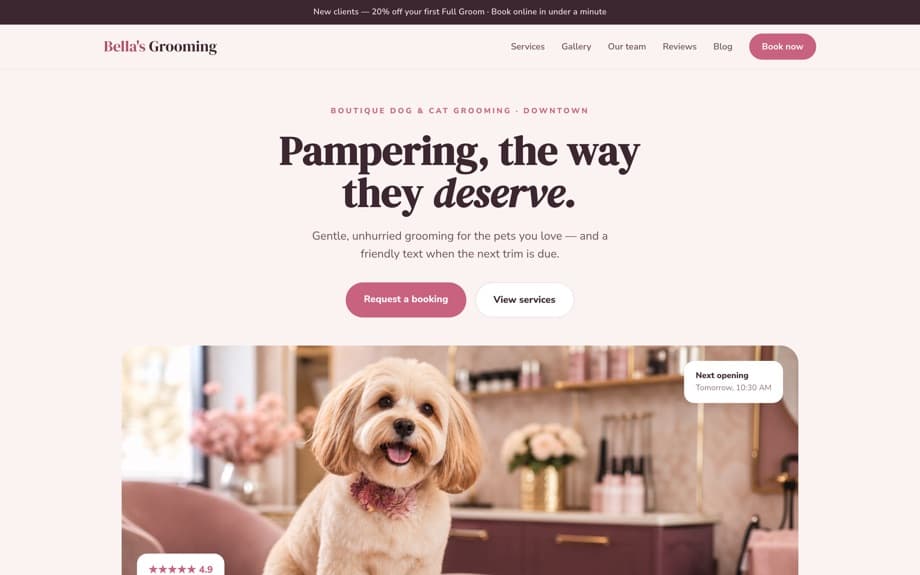
Two limits worth stating plainly, because a post about money should not oversell the tool. Our reminders go out by email, not text message, so if your book currently runs on SMS that is a real difference to weigh. And we do not run payroll or calculate commission splits. The revenue figure on the dashboard reflects payments processed through Growth Onward, as our page on understanding your revenue says directly, so anything you take in cash at the counter and everything you owe a groomer on Friday still lives in your accounting, not in ours.
You can see a grooming salon running end to end on the live demos, including putting a test booking through, or read what we build specifically for grooming salons.
Run your own numbers
The answer to how much dog groomers make is a formula, not a figure. Dogs per day, times average ticket, times the split. For an owner, the same formula runs twice, once for the chair you work yourself and once for every chair you fill with someone else.
Open a spreadsheet and put your own four numbers in. Most owners we talk to find the surprise is not the pay rate. It is how much of the year is sitting in unsold chair-hours. For the wider picture of running the salon around those numbers, our pillar guide on running and growing a dog grooming business picks up where this one stops.