Dog grooming business names that clients can find
Good dog grooming business names say grooming, survive a phone call and match your Google profile word for word. Our six checks and a short list of patterns.

On this page
- A good dog grooming business name tells a stranger what you do, can be spelled after hearing it once, and fits unchanged on your sign, website, Google profile and social handles.
- Put the word grooming in the real name. Google does not let you add service words to your Business Profile name unless they are part of the name you actually trade under.
- Apostrophes, ampersands and spaces cannot go into a web address, so test how the name survives being squashed into a domain and a handle before you commit.
- Check the name against your business registry, your trademark register and a map search of your own town before you print anything.
A good dog grooming business name does three jobs at once. It tells a stranger you groom dogs, it can be spelled by someone who has only heard it said, and it fits unchanged on your sign, your website address, your Google Business Profile (the listing that shows on Google Maps and in local search) and your social handles. The pattern that does all three most often is simple: one memorable word plus the word "grooming", as in Harbor Dog Grooming or Maple Street Grooming.
This guide is for groomers naming a new salon, van or home studio, or thinking about renaming one they already run.
Most lists of dog grooming business names give you three hundred puns and stop there. We build booking websites for grooming salons, so we see the other half of the problem: what happens to the name once it has to work as a web address, a profile name and the line at the top of every confirmation email. Treat this as our view rather than neutral advice. The checks below apply in any country, though the registry and trademark office you use will be your own.
What makes a good dog grooming business name?
Run every candidate through these six checks. A name that fails one is not ruled out, but you should know which one it fails and why you are accepting it.
| Check | How to test it | Why it matters |
|---|---|---|
| Says what you do | Show it to someone who knows nothing about you and ask what the business is | A name that needs a tagline to explain it spends your sign space and your profile name explaining itself |
| Survives the phone | Say it once to a friend and ask them to type it | Referrals arrive by word of mouth, and a name that gets misspelled sends people to someone else's search result |
| Fits Google's name rules | Read it as it would appear on your Business Profile, exactly as on your sign | Google will not let you add words to the profile that are not in your real name |
| Squashes into an address | Remove spaces, apostrophes and ampersands and read what is left | Web addresses and most handles only allow letters, numbers and hyphens |
| Is free | Search your business registry, your trademark register and a map of your town | Two salons with similar names split each other's reviews and phone calls |
| Leaves room to grow | Ask whether it still fits if you add cats, a second site or a van | A name tied to one street or one service can outlive its fit |
Why should the word grooming be in the name?
Because Google will not add it for you. Google's guidelines for representing your business say your profile name must reflect your real-world name, as used on your storefront, website and stationery. They list service or product information among the things you may not add unless it is part of that name, and they warn that including unnecessary information can get a profile suspended.
In practice that splits names into two groups. If your sign says Harbor Dog Grooming, your profile can say Harbor Dog Grooming, and a stranger scanning a map of grooming results knows what you are before they read a word of your listing. If your sign says Harbor, your profile has to say Harbor, and the rest of the work falls on your category and your photos.
We hit this ourselves. One of the demo grooming salons we run is called Furtail. The logo on the storefront says only "Furtail", so the page has to say "grooming" in its headline, and its web address carries the descriptor the logo leaves out: furtail-petgroomers.growthonward.com. A coined name can work, but it needs the word grooming placed somewhere else every single time.
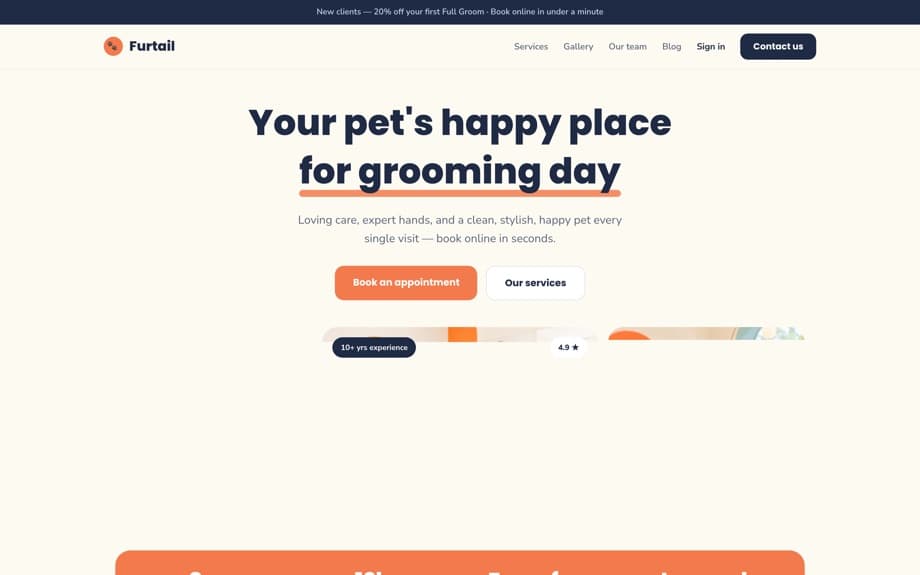
Furtail, a live grooming site we run. The header shows only the coined name, so the headline has to carry the word grooming.
Which name patterns work for a grooming business?
Here is a short list of patterns rather than a long list of names. Every example is illustrative. Someone in your area may already trade under it, which is what the free check is for.
| Pattern | Examples | What a stranger learns | Watch out for |
|---|---|---|---|
| Place plus grooming | Harbor Dog Grooming, Maple Street Grooming, Northside Pet Grooming | What you do and roughly where | Outgrowing the place if you move or expand |
| Person plus grooming | Bella's Grooming, Grooming by Dana | What you do, and that a real person runs it | Harder to sell the business later, and the apostrophe drops out of the address |
| Image plus grooming | Fern and Fur Grooming, Copper Tail Grooming | What you do, plus something to remember | Image words that are already common in your area |
| Coined word | Furtail, Woofwell | Nothing until they read the rest of the page | Every sign, profile and listing has to explain it |
| Pun | Short Tails Grooming, Shear Delight Dog Grooming | What you do, if the pun lands | Spelling. A pun said aloud is easy to type wrong |
The person pattern is the one we see cause the most quiet friction. Our other demo salon is Bella's Grooming. Its web address is bellas-grooming.growthonward.com, because an apostrophe cannot go into an address. That is fine, but it means the name has two spellings in the world, and a client typing it from memory may try either.
How do you check a grooming business name before committing?
Do these in order. The first two are free and take five minutes, and they knock out most candidates.
- Say it on the phone. Call a friend, say the name once, and ask them to text it back to you. If it comes back misspelled, a referral will be misspelled too.
- Search a map of your town. Search the name and the plain words "dog grooming" on a map of your area. A similar name nearby will collect some of your reviews and calls, and you of theirs.
- Check your business registry. Your local registry, whether you form a sole trader business, a limited company or an LLC, will refuse a name too close to one already on file. Our post on whether you need a license to groom dogs covers the rest of the registration side.
- Check your trademark register. A registry accepting a name does not mean nobody holds the trademark. Search your national trademark office's free database for the distinctive word in the name. In the US that is the USPTO trademark search; in the UK it is the government trade mark search. Other countries run their own.
- Squash it into an address and a handle. Drop spaces, apostrophes and ampersands, then check the domain and the social handles. Instagram usernames top out at 30 characters, so a long name may need trimming, and the trimmed version should still be recognisable.
- Decide now about symbols. Google asks for real-world proof, such as signage or invoices, before it will show special characters like an ampersand in your profile name. If you want the "&", put it on the sign from day one.
What names should you avoid?
A few kinds of name cause trouble regardless of how good they sound.
- Near copies of a local salon. Even if the registry accepts it, the reviews and calls will blur.
- Words your registry restricts. Bank and insurance are restricted in many places, and anything suggesting veterinary care can raise questions with your local licensing authority if you are not a vet.
- Names that only make sense with a tagline. If you would have to add "dog grooming" after it everywhere, Google will not let you add it to the profile anyway.
- Names tied to something you may outgrow. A street name if you plan to move, "dog" if you plan to take cats, a neighbourhood if you plan to go mobile. Our guide to starting a mobile dog grooming business covers why a van's service area tends to grow.
Where does the name show up once you are taking bookings?
More places than most owners plan for. Count them on a new salon: the sign, the business registry, the bank account, the web address, the Google profile, the social handles, the printed cards, and every email a client receives. That is eight places, and the last one is the one clients see most.
On Growth Onward, the name you enter under business details appears on your public booking site and in the confirmation and reminder emails clients receive, and saving a change updates both straight away. Our reminders go out by email, so in practice your name arrives in a client's inbox every time a dog is due back, which is one more reason to choose a name they will recognise at a glance. What we do not do is check name availability, register your company or move your Google profile, domain and sign for you. Those stay with you.
Pick the name that works hardest
The best dog grooming business name is rarely the cleverest one on your list. It is the one that says grooming, gets typed correctly after one hearing, and can sit on your profile, your address and your sign without being altered. Run your shortlist through the six checks, keep the two that pass them all, and then pick the one you like saying.
If you are naming a salon because you are starting one, our guide to how to start a dog grooming business covers the steps around it, and how to get more grooming clients picks up once the sign is up. You can see the booking sites we build for grooming businesses, or try booking on the live demos. More posts on the trade sit in our pet grooming hub.