How much do mobile dog groomers make? The owner math
How much do mobile dog groomers make? Our worked owner model runs from about $33,000 to $68,000 a year, and the drive between stops decides where you land.
On this page
- On our worked model, a solo mobile groomer keeps about $33,000 to $68,000 a year before tax, from the same van, the same $90 ticket and the same nine hour day.
- The difference is the average drive between stops. Fifteen minutes fits six dogs into the day, forty-five minutes fits four.
- Fuel is the smaller part of the cost of a scattered route. The larger part is the dogs that no longer fit.
- A loose route can mean more than 500 hours a year behind the wheel, all of it unpaid.
A solo mobile dog groomer makes roughly $33,000 to $68,000 a year before tax on our worked model, from revenue of about $66,000 to $99,000. Both ends of that range use the same van, the same $90 average ticket and the same nine hour working day. The only thing that changes between them is how long you drive between one dog and the next.
This is written for a groomer who owns or is about to buy the van and works it alone. If you are weighing an employed mobile job, the pay works differently, and our groomer earnings breakdown covers commission.
Drive time is the part of the answer the published salary figures leave out. They average employed groomers or quote a range with no workings. We build booking software for grooming businesses, so treat what follows as our view rather than neutral advice, and re-run every line with your own numbers. The figures are in US dollars as a reference point, and the arithmetic works the same in any currency.
What goes into a mobile groomer's income?
Four inputs decide it: dogs per day, average ticket, working days a year, and what the van costs to run. The first one does most of the work, and on a mobile rig it is set by drive time far more than by how fast you groom.
Here are the assumptions we use throughout. Change any of them and the table below moves.
| Assumption | Our figure | Why |
|---|---|---|
| Average ticket | $90 | A $75 salon average plus a 20 percent mobile premium |
| Time per groom, including setup | 75 minutes | One dog at a time, no crate time to overlap |
| Working day | 9 hours | Including the drive out and the drive home |
| Grooming days | 4 a week, 46 weeks | The fifth day goes on cleaning the van, restocking and admin |
| Van and build-out | $60,000 financed over 5 years at 8 percent | About $1,217 a month |
| Insurance, commercial auto and liability | $300 a month | |
| Software and website | $60 a month | |
| Permits across your service area | $40 a month | |
| Fuel and wear | $0.55 a mile at 25 mph average, plus $10 a day for the generator | |
| Shampoo and consumables | $3 a dog | |
| Card processing | 3 percent |
The $75 salon ticket comes from our breakdown of how much dog groomers make, and the 20 percent is the bottom of the 20 to 40 percent mobile premium in our guide to starting a mobile dog grooming business. That guide also covers what the van and build-out cost to buy, so we do not repeat it here.
How much do mobile dog groomers make per day, per month and per year?
By "route" we mean the order and spread of one day's stops, and the number that describes it is the average drive per stop: total minutes driven that day divided by the dogs groomed. Take the nine hour day as 540 minutes. Each dog costs 75 minutes of grooming plus however long it takes to reach it. So the number of dogs that fit is 540 divided by (75 plus the average drive per stop), rounded down.
| Tight route | Typical route | Scattered route | |
|---|---|---|---|
| Average drive per stop | 15 min | 30 min | 45 min |
| Dogs per day | 6 | 5 | 4 |
| Revenue per day | $540 | $450 | $360 |
| Revenue per year (184 days) | $99,360 | $82,800 | $66,240 |
| Fuel, wear and generator | $5,635 | $8,165 | $9,430 |
| Consumables | $3,312 | $2,760 | $2,208 |
| Card fees | $2,981 | $2,484 | $1,987 |
| Van payment, insurance, software, permits | $19,404 | $19,404 | $19,404 |
| Owner keeps, before tax | $68,028 | $49,987 | $33,211 |
| Per month, the year averaged out | about $5,670 | about $4,170 | about $2,770 |
| Per grooming day | about $370 | about $272 | about $180 |
The monthly line is the annual figure divided by twelve, not a good week multiplied out. Six weeks of the year are unworked, and they come out of your income, not an employer's payroll.
Tax is not in the table because it depends on where you live and whether you trade as a sole trader, a limited company or an LLC. Income tax and any self-employment contributions come out of the bottom line, so hold back a share of every month for them.
Why does drive time matter more than the price of fuel?
Look at what actually changed between the tight route and the scattered one. Fuel and wear went up by about $3,800 a year. Revenue went down by $33,120. The fuel is the cost you see on the card statement. The two dogs a day that no longer fit are the cost you never see, because they were never booked.
That is why the gap between the columns is so large. Every extra 15 minutes of average drive per stop costs this owner roughly $17,000 to $18,000 a year, and almost all of it is lost grooms, with gas a small share.
It also shows up as time. On the typical route, 150 minutes a day go on driving. Across 184 grooming days that is 460 hours a year. On the scattered route it is 552 hours, close to 14 working weeks of 40 hours, all of it unpaid.
How much do mobile dog groomers make per hour?
It depends which hours you count, and the difference between the two answers is the drive.
| Tight route | Typical route | Scattered route | |
|---|---|---|---|
| Per hour, all working hours | about $41 | about $31 | about $23 |
| Per hour, grooming hours only | about $49 | about $43 | about $36 |
The second row is the number that feels true while you are standing at the table. The first row is the one your year actually pays. If you quote your hourly rate to yourself from the grooming hours only, a scattered route will look nearly as good as a tight one when it is paying you about half as much.
Do mobile groomers make more than salon groomers?
Per dog, yes. Per year, only on a tight route.
In our groomer earnings breakdown we worked a solo salon owner on the same four day week. Our mobile owner on the tight route keeps comfortably more than that salon owner, because the $90 ticket carries no rent. On the scattered route the mobile owner keeps less than the salon owner, while charging more for every dog. Which of those you are depends on the shape of the diary more than on the van.
How do mobile groomers get onto the tight route?
Almost everything that moves you left in that table is scheduling.
- Give each area its own day. Mondays in one part of town, Tuesdays in another. A new client joins their area's day rather than whichever gap is open.
- Rebook on a fixed interval. A regular who comes back every six weeks on the same weekday is a stop you can plan around. A client who calls when the coat gets bad lands wherever there is a gap. We wrote about setting that interval by breed and coat in how often you should groom your dog.
- Price the trip, not only the dog. If a client sits well outside your areas, a travel fee or a two dog minimum turns a 45 minute drive into something that pays for itself. Our dog grooming pricing guide covers building those into the price list.
- Protect every slot. A mobile no-show loses the $90 groom and the drive to reach it. One a week across 46 weeks is $4,140 of revenue gone, and on a mobile rig almost none of your costs fall with it. Our guide to reducing no-shows has the full playbook, and the grooming salon no-show policy template works just as well from a van.
What Growth Onward does for a mobile groomer
We build the booking side of that list. A mobile groomer on Growth Onward gets a booking website in their own name, where clients book and pay online without a phone call. Our help page on choosing how you charge shows how to take a deposit at booking, so a no-show costs the client something too. The page on recurring visits shows how a rebooking reminder goes to each client by email when their dog is due, with a link to book the next visit.
Two settings matter more on a van than in a salon. Under setting your availability you choose which days you take bookings and how long each slot is, so you can make the slot long enough to include the drive and never offer two back-to-back starts you cannot physically reach.
What we do not do is plan your route or sort bookings by zip code or postcode. Grouping areas by day is a decision you make and hold to. The software keeps the diary full and the regulars coming back on time, which is the part that is easy to let slide.
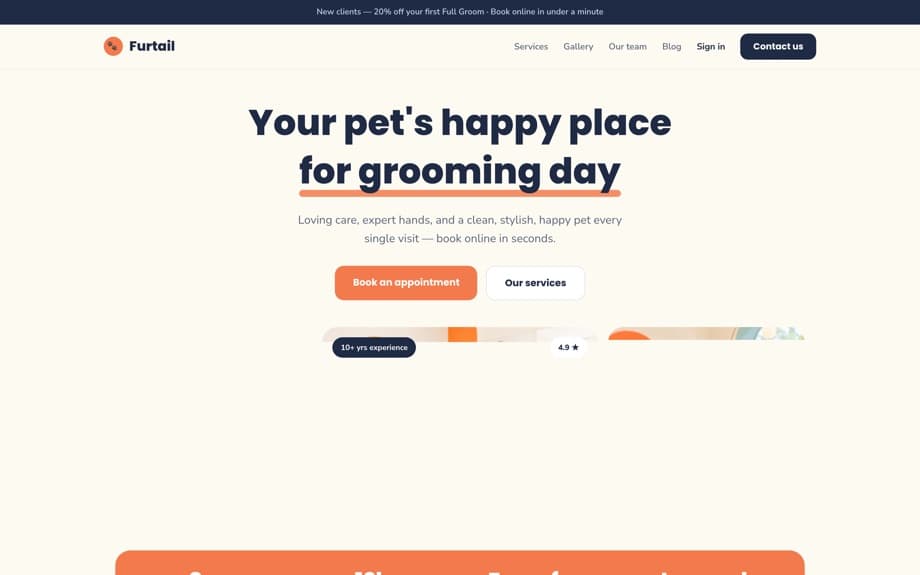
That is Furtail, one of the live grooming sites we run. You can try booking on the live demos, or read what we build specifically for grooming businesses.
Run your own route
How much mobile dog groomers make comes down to one question most owners never measure: the average drive between stops. Take last month's diary, add up the minutes between the end of one groom and the start of the next, and divide by the number of dogs. Then find your column in the table above.
If the answer is closer to 45 minutes than 15, the fastest raise available to you is fewer miles between the dogs you already have. For the wider picture of running the business around those numbers, our guide to running and growing a dog grooming business picks up from here.