How to start a car detailing business (costs and clients)
How to start a car detailing business, with a worked startup cost table, the first ten clients, and the arithmetic that decides your first year.
On this page
- Our worked startup figures are about $480 for a bare start, $2,350 for a working mobile setup, and $5,710 for a fixed unit.
- Fifteen cars at a $180 ticket pays back the working setup. After that the constraint is booked work, not equipment.
- Six cars a week across a year clears roughly $38,800 before tax on our model. Three cars a week clears about $16,500.
- Start mobile unless you already have bookings. Rent is the cost that turns a quiet month into a loss.
To start a car detailing business you need about $480 of equipment, a registration with your local licensing authority, insurance, and a way for people to book you. Three of those four take a weekend. The fourth is the whole business, and it is the one page one of this search spends the least time on.
This is written for the person about to start, not for a shop that already has a diary. It covers what the launch costs, how fast that cost comes back, and where the first ten customers come from. It does not cover detailing technique, product brands, or paint correction training, because there are people far better placed than us to teach those.
All figures here are in US dollars as a reference point. The arithmetic works the same in any currency, so put your own numbers in and re-run it.
How much money do I need to start a car detailing business?
Here are the three versions of the answer, priced out as we would put them in a plan. The columns are not better and worse, they are different bets.
| Item | Bare start | Working mobile setup | Fixed unit |
|---|---|---|---|
| Pressure washer and hoses | uses the customer's tap | $220 | $380 |
| Wet and dry vacuum, extractor | $90 | $260 | $900 |
| Polisher, pads, compounds | none yet | $340 | $520 |
| Chemicals, towels, brushes, buckets | $180 | $420 | $600 |
| Water tank, generator, rack | none | $650 | not needed |
| Registration and first month of insurance | $150 | $150 | $150 |
| Booking site, domain, software first month | $60 | $60 | $60 |
| Unit deposit and first month of rent | none | none | $2,400 |
| Signage, vehicle graphics, first print run | none | $250 | $700 |
| Total | $480 | $2,350 | $5,710 |
The bare start column lands at $480, which is close to the $500 figure the videos and guides on page one all quote. That is a useful check that the model is not doing anything strange, and it is also where the useful part of that figure stops.
What $480 buys is a kit. It does not buy a water supply, so you are asking every customer for their outside tap. It does not buy a polisher, so you cannot sell correction work, which is where the ticket goes up. And it does not buy a single booking. We would treat the bare column as a way to test whether you enjoy the work before spending real money, not as a business you can run for a year.
What do you need in place before the first paid car?
Five things, and only one of them is equipment. Work through this list before you take money from anyone:
- A registered business. Sole trader, limited company or LLC, depending on where you are. Your local licensing authority sets the rules and they are not the same in two towns, so ask them rather than a forum.
- A general business license, and the wastewater rules. If you wash outdoors, run off is the part new detailers miss, and it is the part with a fine attached.
- Insurance that covers the customer's car, not just your own liability. General liability and cover for vehicles in your care are two different policies. We do not sell or broker either, so take that from someone who does.
- A price you can say out loud. Three services with a price and a duration each. Not "it depends".
- A booking link. Somewhere for the first enquiry to land that is not a phone you will be holding a polisher next to.
How many cars does it take to pay the kit back?
This is the question we would ask before any of the equipment questions, and page one never asks it.
Take the working mobile setup at $2,350. Set an opening average ticket of $180, which is deliberately below what an established shop charges. Now the running costs, split honestly into the ones that arrive every month and the ones that arrive per car:
| Cost | Amount |
|---|---|
| Insurance, monthly | $95 |
| Booking software and website, monthly | $60 |
| Fuel and travel, monthly | $140 |
| Fixed per month | $295 |
| Chemicals, pads, towel laundry, per car | $12 |
| Card processing at about 3 percent, per car | $6 |
| Variable per car | $18 |
Every car you detail contributes $180 less $18, so $162. Two cars a month covers your entire fixed cost. Fifteen cars pays back the whole $2,350 setup.
Fifteen cars. Not fifteen a week, fifteen in total. On any realistic ramp that is somewhere between three weeks and two months of work, and after it the equipment question is closed forever. Everything that decides your first year from that point sits in one number, which is how many cars are booked.
Run the year twice to see how much that one number moves:
- Six cars a week, 46 working weeks, is 276 cars. At $162 each that is $44,712, less $3,540 of fixed costs and the $2,350 of setup, so about $38,800 before tax in year one.
- Three cars a week is 138 cars, $22,356, less the same $3,540 and the same $2,350, so about $16,500.
Half the cars costs you well over half the year, because the fixed costs and the kit do not halve with them. We build the software that small detailing shops run their bookings on, so treat this as our view rather than neutral advice: our position is that the startup budget is the least interesting decision you will make in your first six months, and the booking rate is the only one that matters.
The same arithmetic run from the other end, on what an established detailer takes home once the diary is full, is in how much car detailers make. That post also works out how many cars one person can genuinely do in a day, and which services earn the most per hour of bay time, so we are not going to repeat either here.
Mobile or a unit?
Start mobile unless you already have work booked.
A unit gives you a controlled space, somewhere to leave a car overnight, and a fixed address that makes people take you seriously. It also adds rent that arrives whether cars do or not. In the table above the unit column carries $2,400 of deposit and rent before you have detailed anything, and then that rent repeats every month, which is exactly the cost that turns a slow month into a loss rather than a quiet one.
Mobile trades that fixed cost for travel time. Travel is unpaid, and it is the reason a mobile operator with a tight route and a loose one can charge identical prices and end the year in different places. That flexes, though. A slow week costs a mobile detailer some fuel. A slow week costs a unit its rent.
What does the service menu need to look like?
Three tiers, priced by how long each one takes you rather than by how it sounds. A maintenance wash and interior tidy, a full interior and exterior detail, and one premium service that gives you somewhere to send the customer who wants more.
The reason to set durations properly on day one is that they are what your calendar reserves. If a full detail is really three and a half hours and you list it as two, you will sell yourself into a diary you cannot physically work, and every customer after the overrun waits. Our guide on managing your services covers where price and duration are set, and setting your availability covers turning those durations into slots people can actually book.
Set the money question at the same time. You can take nothing online, take a deposit, or take the full price at booking, and our page on choosing how you charge walks through which suits a new detailer. Our own view is that a small deposit is worth more to a new business than to an established one, because you have no reputation yet to make people show up out of habit.
How do you get your first ten clients?
Here is the order we would run it in. It is deliberately unglamorous.
- Get the booking link live before you post anything. Not a phone number, a link. Every photo you put anywhere from that day forward has somewhere to send people, and you never lose an enquiry because you were under a car when it came in.
- Book the first five at a fixed introductory price, not free. Free work attracts people who will not pay later, and it gives you no evidence of what someone will actually hand over.
- Photograph every car before and after. Same angle, same light. Ten cars in you have a portfolio nobody can copy, and it is the only asset in this list that competitors cannot buy.
- Ask for the review at sign-off. The moment the customer sees the car is the moment they mean it. Review requests fire off completed bookings automatically in our system, and you approve each one before it goes public, which is covered in our guide to collecting reviews.
- Give the first five a reason to send you a sixth. A referral link with a reward you set turns a happy customer into a channel rather than a one off.
- Rebook before they drive away. A detail is a repeat service and most owners treat it as a one off purchase. Booking the next one while the car still looks new is the highest conversion moment you will ever get.
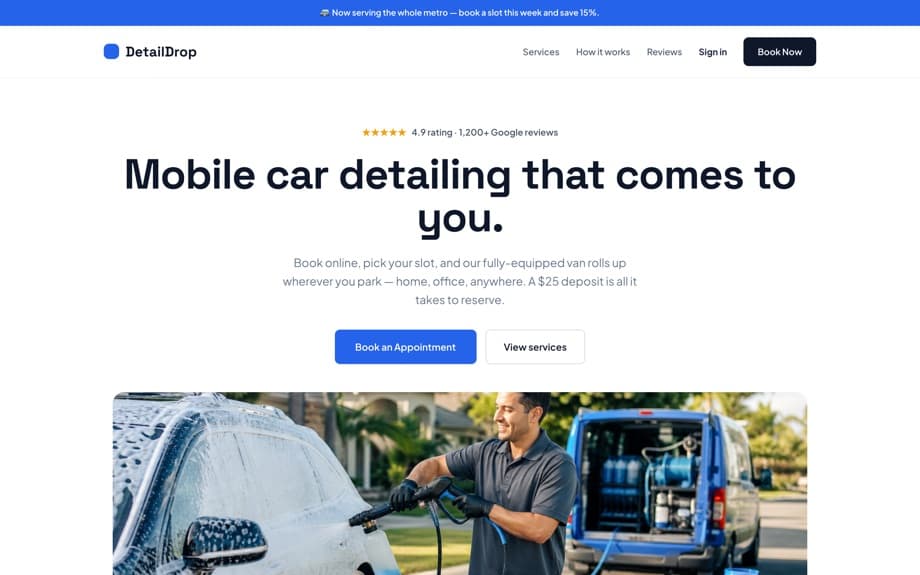
That is DetailDrop, one of the live storefronts we run, and it is roughly what step one looks like in practice. Packages with prices, durations behind them, and a booking button that reserves a real slot. Our first steps guide is the shortest path from nothing to a bookable page.
What we would tell you not to do
Three things, from watching this happen in more than one trade.
Do not buy the polisher before you have the diary. The equipment ladder feels like progress and is not. Every upgrade you make before the calendar is full raises your fixed costs against the same number of cars.
Do not run the business out of a phone. A missed call at 4pm on a Friday is a booking that goes to whoever answered. This is the single most common way small operators lose work they had already earned, and we wrote out why in why online booking beats phone tag.
Do not treat a no-show as bad luck. It is a priced event. One lost booking a day is a specific number of dollars a year, and there are two or three settings that change how often it happens, which we cover in reducing no-shows.
Three honest limits on our side, because a post about starting up should not oversell the tool. Our rebooking and review reminders go out by email, not text message, so if your customers expect a text the day before, that is a real difference to weigh. We do not sell or broker insurance, and we do not register your business or file anything with a licensing authority, so both of those stay entirely on you. And your site is a template you edit rather than a bespoke design, which is the trade we make deliberately so it can be live the same day.
You can see a detailing business running end to end on the live demos, put a test booking through it, or read what we build for detailing shops and auto trades.
The first year in one sentence
Starting a car detailing business is a $480 to $2,350 decision followed by a fifty week booking problem.
The equipment question resolves itself in about fifteen cars. The booking question does not resolve at all, it just gets managed better or worse, and the gap between managing it well and badly was $22,000 in the model above with no change to a single price. If you want the wider version of that argument across every local trade we work with, it is in how local service businesses get and keep customers, and the same startup arithmetic run for a different trade is in how to start a dog grooming business.